While green building standards are mandatory for large Category Four and Five buildings, all projects are encouraged to incorporate climate-resilient features
As Rwanda continues to pursue urban development aligned with environmental protection and climate resilience, a clear gap emerges between policy and practice in City Construction. While large urban projects adhere closely to Green Building Minimum Compliance standards, smaller residential constructions often implement environmental guidelines only on paper, leaving blueprints largely symbolic.
After the training organized by REJ with the support of FOJO Institute, the Rwanda Environmental Journalists’ association prepared to produce stories for the journalists who had already been trained so that they could put into practice what they had learned.
A tour of Rwanda’s cities, including Kigali and eight secondary cities (Nyagatare, Musanze, Rubavu, Rusizi, Huye, Karongi, Kirehe, and Kayonza), reveals modern high-rise commercial buildings alongside meticulously designed residential complexes. Yet, a closer look shows that compliance with environmental regulations varies significantly depending on project size and ownership.
We are confident that the implementation of this National Roadmap will help develop green secondary cities in a holistic manner, providing new economic and social opportunities to all Rwandans. The development of secondary cities constitutes a major project for Rwanda, and it requires the participation and ownership of the civil society and all government stakeholders
This is from Official Gazette no. Special of 16/04/2019. Rwanda has shown impressive strides in economic growth in the recent decades. This economic development has set off a construction boom in the capital of Rwanda identified under the erstwhile Economic Development and Poverty Reduction Strategy (EDPRS) 2013-18 as poles of growth and centers of non-agricultural economic activities.

The water used in the entire house is collected together for reuse after treatment, so this hole is visible in this photo, showing where it is collected.
Buildings are also major consumers of potable water – a finite resource. If not planned for and used judiciously, poor water management would have significant impact on the ecosystem. Buildings also have significant impact on human health, wellness and productivity, as many of us spend 90% of our time indoors, and our physical environment impacts our health more than lifestyle, medical care and genetics.
Green City Kigali
Project is the most ambitious initiative, planning to eventually host 30,000 green housing units across 600 hectares, starting with a 1,700-unit pilot, A massive 600-hectare project in Kinyinya designed to house 150,000 people in 30,000 green housing units, targeting carbon neutrality by 2050.
I&M Bank Headquarters
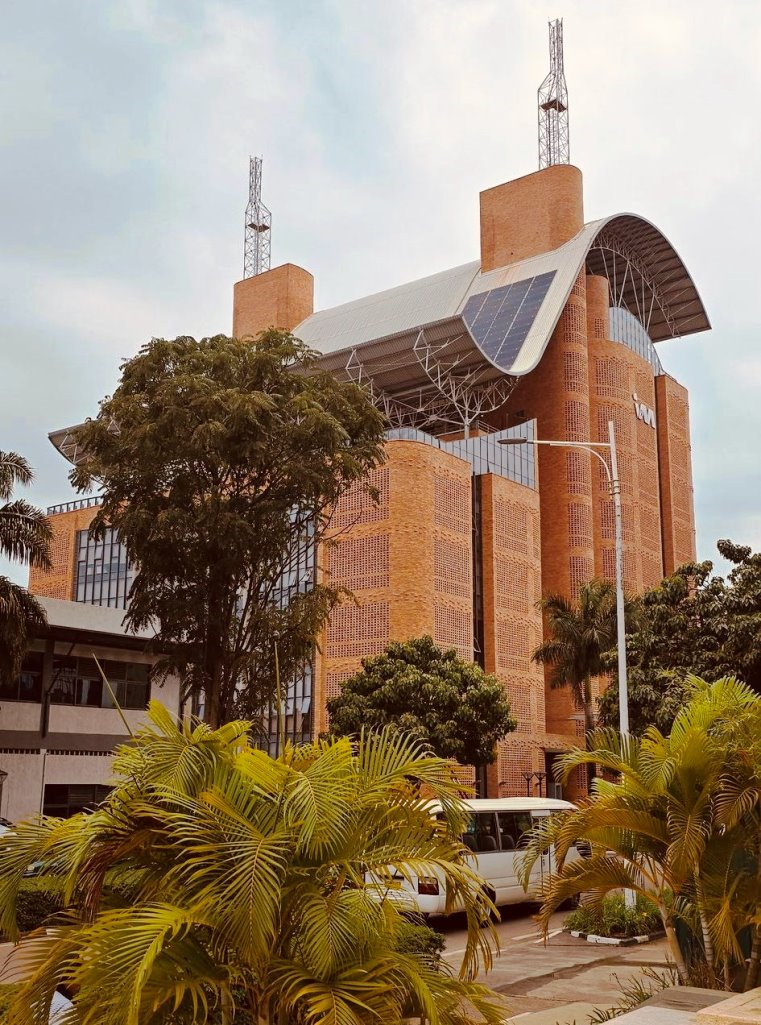
A sustainable construction featuring solar power and locally manufactured materials to reduce cooling needs and building is self-ventilated no air conditioners needed. Features locally manufactured bricks and roofing that generates 210 kilowatts of solar power.
The Green Building Minimum Compliance System
Launched in 2019 through Rwanda’s Official Gazette, the GBMCS is a set of sustainability requirements for certain new buildings. It applies to new Category 4and 5 developments, which include:
- Commercial buildings (excluding warehouses and shops)
- Public institutions and administrative buildings
- Healthcare facilities
- Educational institutions (excluding student housing)
- Social, cultural, and assembly buildings
What is a Green Building?
Green building is defined differently by various users, but there is a consensual agreement on the fact that it is an outcome of a design philosophy, which focusses on increasing the efficiency of resource use while reducing building impacts on human health and the environment during the building life cycle
Why green building?

Rwanda has set clear development goals: increase urbanization from 16.5% in 2012 to 35% by 2024, promote economic growth in secondary cities, and meet climate targets under the Paris Agreement. At the same time, buildings account for more than 60% of energy use in East African countries and contribute significantly to carbon emissions and water consumption.
Green building isn’t just a trend, it’s a necessity. It offers smarter, more efficient ways to design, build, and operate our spaces while reducing environmental harm.
Green standards enforced in large-scare projects
In Kigali, a visit to the construction site of the Umuyenzi City Center (UCC), a flagship commercial building, highlighted the practical application of Green Building Minimum Compliance standards.
Eng. Marius Abayisenga, overseeing construction at UCC, explained that environmental considerations were central from design to execution.
“We follow Green Building Minimum Compliance strictly. Our building has numerous solar panels, and we plan to use solar energy for lighting. All water used in the building is collected, stored in tanks, treated, and reused. We have a large wastewater treatment system to ensure used water is cleaned before reuse or release, preventing environmental damage. Terraces will be planted with grass, and indoor temperature is managed with proper ventilation,” Eng. Abayisenga said.
In Musanze, Eng. Muhutangabo Joseph, responsible for supervising one among commercial buildings, emphasized similar measures:

“Environmental protection is a priority. We have a staged wastewater treatment plant, and treated water is either reused or safely discharged. The building’s design includes balconies with flower pots and greenery to improve air quality. Solar energy and natural lighting are fully integrated. Ignoring these approved plans would lead to serious environmental and structural consequences.”
Small residential buildings: Green Building Minimum Compliance standards are only on paper
By contrast, smaller residential projects, particularly those privately owned, frequently diverge from their approved plans.
Residents and workers report that many construction blueprints intended to protect the environment, such as gardens, tree planting, and proper wastewater management, are often ignored during construction.

Karinda Paul, a construction worker in Musanze, described the situation bluntly: “I follow exactly what the client wants. Designing a toilet system with a sealed base is possible, but when space is limited, gardens are sacrificed. The plans mainly exist to secure a building permit. In reality, there’s no intention to plant trees or maintain green spaces.”
In Kigali, Manirakiza, known locally as Kazungu, highlighted another common issue: “Wealthy homeowners rarely cement the bases of toilets and water pits. Areas that should be gardens often become parking spaces. These blueprints exist to get construction permits only; the practical implementation is completely different.”
Mukansanga, a craftsman in Nyarugenge District, echoed these observations: “Even when green spaces are planned, walls are built without following through on gardens. People prefer to construct small annexes for rental income rather than plant trees. No inspector comes to ensure compliance; permits are enough to proceed.”
Authorities acknowledge the gap
Emma Claudine Ntirenganya, spokesperson for the City of Kigali, confirmed that while large projects generally comply with environmental require Green Building Minimum Compliance standards, smaller residential buildings often fail to do so.

“Environmental protection applies to everyone, but the approach differs based on the type of building. Large commercial and multi-use buildings are closely monitored, while individual residential projects often show a difference between blueprints and actual implementation. Many submit well-designed blueprints with trees and gardens, but in practice, these features are replaced with paving or parking areas,” Ntirenganya said.
She continued by saying that these guidelines are not just on paper because building environmentally friendly buildings has benefits for those who work in them. An example we can give is the I&M Bank building.
If you build a house that will provide you with air without the need for imported equipment, such as a fan or for the electricity you are using which is mixed with solar energy, you can use materials that are available nearby.
Because bringing in materials from far away reduces the cost. If you follow the guidelines for building environmentally friendly buildings, it is in your interests, especially in the long term, rather than in the interests of the City of Kigali.
Janvier Muhire, Building Regulations Specialist at Rwanda Housing Authority (RHA), explained that all construction should aim for climate resilience, with a focus on efficient water and energy use, rainwater harvesting, and green spaces.

The construction site of the Umuyenzi City Center (UCC)
“While green building standards are mandatory for large Category Four and Five buildings, all projects are encouraged to incorporate climate-resilient features. Local authorities and RHA conduct inspections, and a comprehensive review is planned to assess compliance across existing constructions,” Muhire said.
REMA warns of cumulative impacts
The Rwanda Environment Management Authority (REMA) warns that neglecting environmental regulations, particularly in small-scale construction, can have severe consequences.
“Small buildings may seem insignificant, but their cumulative impact in urban areas is substantial. Improper waste management, water pollution, soil erosion, flooding, and health hazards arise when standards are ignored. Even though Environmental Impact Assessments are not mandatory for small buildings, they must still follow environmental guidelines, and REMA can halt construction when risks are identified,” REMA officials said.
Are there any gaps in monitoring that have caused small buildings to lag behind in complying with regulations?
Based on the evidence, even though no in-depth research has been conducted on the topic you mentioned, it seems that there may be a gap in the monitoring of small buildings because environmental impact assessments are mostly conducted on large projects, which means that small buildings are considered to have no significant environmental impact.
These include:
The cumulative impacts of small buildings are not sufficiently assessed and cause risks; for example, residential sites where many buildings are built together and each person builds as they see fit may have consequences for the environment and the well-being of the people living in these sites and their surroundings.
It is possible that daily inspections are carried out with capacity constraints, there may be few inspectors and insufficient knowledge in environmental matters; especially since they often only focus on ensuring compliance with the provisions of the land use plan
In some cases, building permits are issued before an environmental analysis is carried out and the buildings were already in the operational phase.
REMA works closely with local authorities, which issue building permits, including urban authorities and the Rwanda Housing Authority (RHA), to ensure that all buildings, regardless of their size, comply with environmental protection regulations.
Collaboration with other institutions helps small buildings, even if they do not go through an environmental impact assessment study, to be subject to effective monitoring based on their environmental impact and helps reduce the risks of unplanned urban development.
Despite this, REMA and the Government in general continue to work together to find solutions to existing problems with the aim of preventing environmental degradation, preventing disasters and achieving sustainable development in general
Experts stress enforcement over legislation
Eng. Uwimana Emmanuel, a construction expert with 20 years of experience, asserts that Rwanda’s urban planning regulations are adequate; the problem lies in enforcement.

“The rules exist for all buildings, large and small. The challenge is implementation. Unmonitored small constructions can damage drainage systems, cause erosion, and pose health risks. Supervision must occur during construction, not after completion,” he said.
The way forward
Rwanda’s rapid urbanization underscores the importance of consistent enforcement. While large commercial projects demonstrate effective compliance with Green Building Minimum Compliance standards, smaller residential constructions lag behind, threatening environmental sustainability and public health.
Authorities are investing in technology, including drones and satellite imagery, to monitor compliance and prevent illegal construction.

“Ensuring buildings meet environmental standards is not just about regulations; it’s about protecting public health, natural resources, and the long-term development of our cities,” Ntirenganya said.
As the RHA and other agencies prepare a nationwide compliance review, it remains clear that bridging the gap between design and execution is critical. The future of Rwanda’s cities depends not only on growth but also on sustainable, environmentally conscious construction practices that benefit all residents.
In Kigali, there are approximately 44 large-scale commercial buildings that have officially integrated green building concepts into their design and operation.
The landscape is rapidly evolving as the city moves from individual projects toward large-scale sustainable urban planning.

In Musanze, one of the second cities of Kigali, high-rise buildings that are environmentally friendly continue to be built and meet all the requirements, according to building officials.

I&M Bank build a house that will provide you with air without the need for imported equipment, such as a fan or for the electricity you are using, which is mixed with solar energy, you can use materials that are available nearby
@Rebero.rw
About The Author